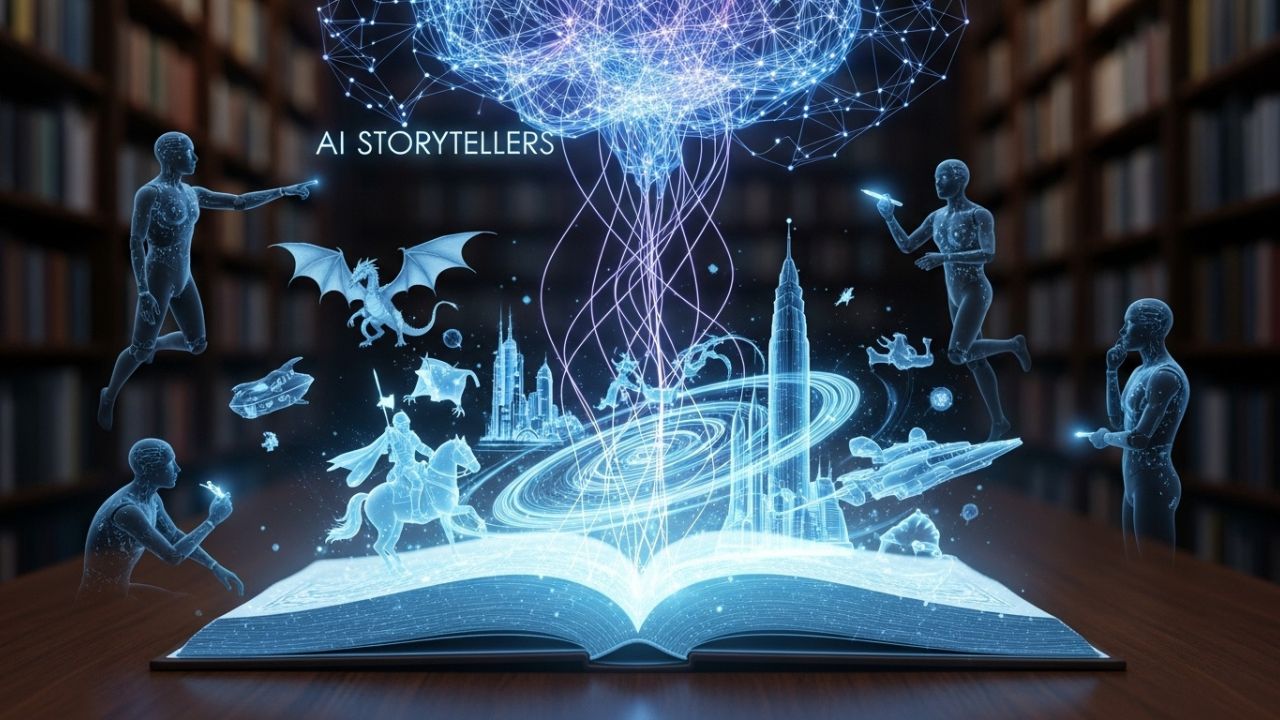
AI Storytellers: In the last five years, artificial intelligence has transformed from a background productivity tool into a mainstream creative partner for writers and publishers. The emergence of large language models (LLMs)—deep learning systems trained on massive text datasets—has redefined how stories are conceived, crafted, and consumed. Today, authors use cutting-edge models not just as grammar checkers, but as co-authors capable of building worlds, developing characters, and generating entire manuscripts in multiple genres. With some bestsellers already co-written by AI, and self-publishing platforms overflowing with AI-assisted novels, a new age of computational storytelling is underway.
The Evolution of AI in Creative Writing
From Proofreading to Plot Mechanic
AI in writing began as simple grammar and style tools: spellcheckers, grammar recommenders, plagiarism detectors. The introduction of neural networks led to predictive text systems, and with the debut of models like GPT-3, writers gained partners that could ideate titles, generate dialogue, and fill in narrative gaps. By 2025, LLMs like Claude Opus 4, Gemini 2.5 Pro, GPT-4.5, and Sudowrite have evolved far beyond autocorrect.
- Early AI: Proofreading, basic grammar.
- LLM Era: Plot suggestion, character building, genre-specific voice, world-building, editorial analysis.
The Market Explosion
The AI writing tool market hit $5.3 billion in 2025, with over 65% of published authors using AI at some stage of the creative process—from ideation to revision and marketing.
Read Also: AI in Advertising: Generating Campaigns, Slogans, and Visuals in Seconds
How LLMs Write Stories: Technical and Creative Insights
Model Training
Large language models learn by ingesting billions of sentences from books, web pages, essays, film scripts, and other documents. The models’ “knowledge” includes genre conventions, stylistic tropes, cultural references, and emotional arcs.
Generation Process
A user supplies a prompt—anything from a simple scenario to a full chapter summary. The AI predicts the next word or sentence based on billions of learned examples, adjusting for requested style, tone, character voice, or pacing.
Advanced Capabilities in 2025
- Genre Mastery: Claude Opus 4 and GPT-4.5 can generate detective fiction, fantasy epics, memoirs, and romance with genre-appropriate tropes and structures.
- Character Consistency: Specialized tools like CharacterGPT maintain persona and voice over hundreds of pages, tracking quirks, arcs, and relationships.
- World-building: Sudowrite and NovelAI generate detailed settings, histories, plot devices, and sensory descriptions at scale.
- Plot Integrity: StoryLab’s narrative intelligence engine detects plot holes, continuity errors, and suggests resolutions.
- Voice Adaptation: Multilingual and style-aware models (Qwen, Gemini) match regional idioms and translate stories for global audiences.
Breaking Down the Creative Process
1. Ideation and Brainstorming
Authors kickstart a novel by prompting the LLM for world concepts, character names, or thematic moods. Many use LLMs for “rubberducking”—explaining ideas to test logic and narrative flow.
2. Drafting and Narrative Generation
LLMs flesh out plot summaries into structured chapters. They can be instructed for show-don’t-tell, pacing, or emotional intensity, outputting prose that drafts entire scenes or fills gaps where human writers stall.
3. Dialogue and Character Development
CharacterGPT and Llama 3.3 70B excel at multi-character dialogue, adapting speech patterns, inner thoughts, and subtext. This enables realistic interplay, escalating tension, or even humor with few manual rewrites.
4. Editing, Continuity, and Revision
Models like StoryLab review drafts for contradictions, plot holes, and stylistic deviations—then propose actionable fixes, ensuring professional polish in less time.
Real-World Success Stories
- Thriller author J.L. Garcia’s “Silent Algorithms”: AI-generated plot twists, while human review added emotional depth, resulting in the series landing a bestselling spot within months.
- Dr. Eliza Chen’s “Frontiers in Immunotherapy”: AI synthesized thousands of papers to create a comprehensive medical text, cutting research and drafting time by half.
- Self-publishing revolution: Amazon and Wattpad now feature thousands of books with AI-assisted drafting. Many indie authors attribute increased creative output to models helping overcome blocks and suggesting novel directions.
Current Limitations and Literary Critiques
Conceptual and Emotional Novelty
While AI can mimic style and adapt voice, critics argue that most generated content is derivative—predicting the next “likely” sentence rather than inventing groundbreaking new ideas. Emotional resonance, subtext, and unpredictable metaphor are less robust in LLMs than seasoned human authors.
Ethical Issues and Plagiarism
Concerns arise around originality as LLMs remix patterns from their training sets. Questions persist about ownership, citation, and the risk of unwittingly reproducing protected intellectual property or mimicking living authors too closely.
Over-reliance on Algorithmic Tropes
Some genres—romance, fantasy, detective—display recurring tropes and outcomes due to AI’s probabilistic approach. Human creativity remains crucial for breaking conventions and introducing fresh literary techniques.
The Human-AI Collaboration Model
“Creative Director” Mindset
Best-selling authors increasingly treat AI as a co-author, guiding direction, adjusting tone, and curating outputs. LLMs generate volume, while humans inject nuance, personality, and narrative risk. As the AI learns user preferences, this synergy often results in richer final drafts, and some innovative storytelling forms that combine machine speed with human unpredictability.
Productivity Gains
Authors report a 50% cut in writing and revision time. Writer’s block is less common, and many find the “first draft” challenge solved by structured AI output that can be sculpted with personalized edits.
Multimodal Storytelling: The Next Frontier
2025 witnesses the dawn of multimodal models that combine text, voice, and video generation. Books can be instantly adapted into audiobooks (with synthesized but emotive narration), graphic novels (through image generation platforms), or interactive web formats. AI now enables authors to deliver stories across formats and languages, expanding creative and commercial reach.
Frequently Asked Questions
Can LLMs write a full novel with minimal human input?
Yes—genre-specific models can generate plot, character arcs, dialogue, and setting at book scale. Most professionals, however, curate and edit outputs for style, emotional depth, and originality.
Are AI-generated books marketable and publishable?
Thousands are being published, but bestseller status typically requires strong human oversight. AI-augmented fiction performs well in fast-growing self-published genres; traditional publishers increasingly use LLMs for research, editing, and formatting.
How do AI writing tools impact traditional authorship?
AI accelerates drafting, diversifies brainstorming, and levels the publishing field for new voices. Yet, the most impactful books maintain a distinctly human sense of voice, structure, and insight.
What are the risks to literary originality and copyright?
AI tools risk remixed tropes and accidental plagiarism from their training material. Best practice is to use them for ideation, structure, and revision, but to ensure human creativity leads the final product.
Will AI ever rival human literary genius?
Current LLMs simulate style and genre with increasing fidelity, but the “lightning strike” of true originality, metaphor, and personal experience is still a human hallmark. AI may amplify but not replace genius.
Read Also: AI for Good or Not: Responsible AI, Ethics and the Dark Side of Autonomous Agents
Conclusion: The Storytelling Landscape Ahead
Large language models are not replacing creative writers—they are redefining what it means to be a storyteller. AI augments drafting, inspiration, and revision, driving higher productivity and unlocking new avenues for multimodal, multilingual publishing. The next generation of bestsellers will likely be born from human-AI collaborations, blending machine precision and volume with the unpredictable spark that defines human artistic achievement. The challenge for tomorrow’s authors is not to compete with AI, but to direct it—channeling computational creativity to enrich stories and engage readers in ways never before possible.