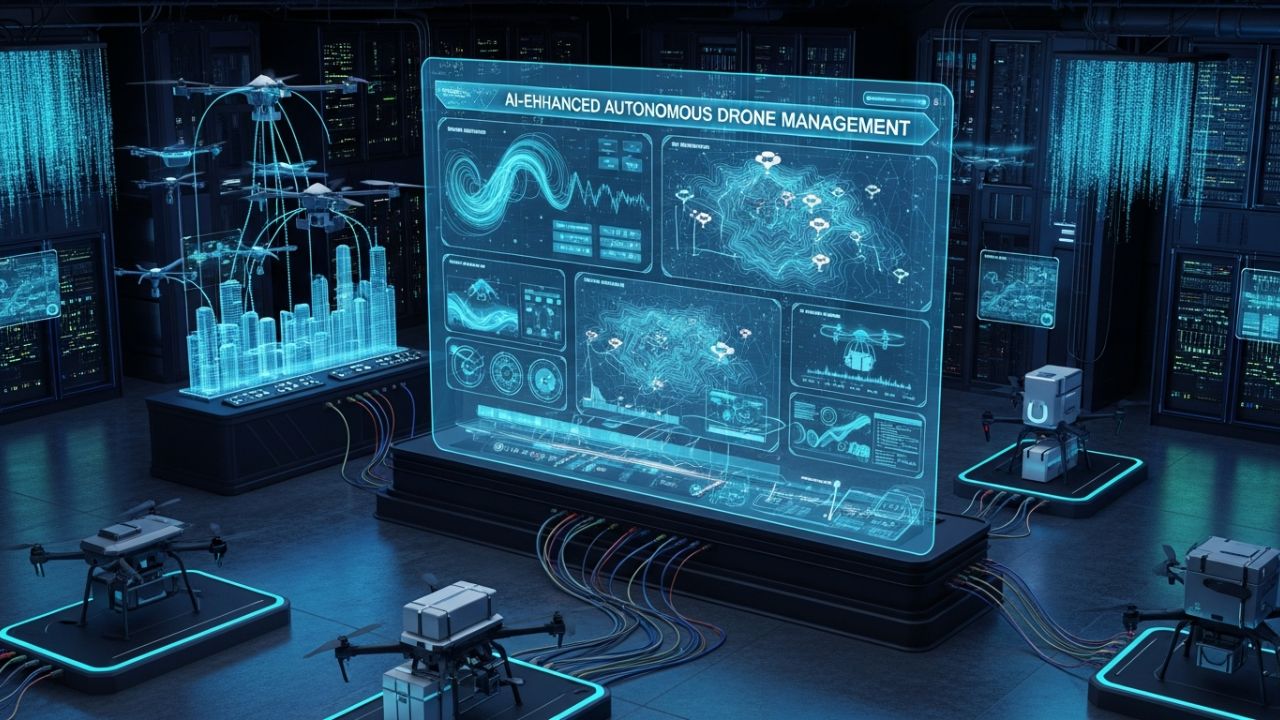
AI-Enhanced Autonomous Drone Management Systems: Drones have rapidly evolved from simple remote-controlled gadgets into powerful autonomous systems capable of performing complex missions across multiple industries. Today, the true catalyst behind this transformation is Artificial Intelligence (AI)—the driving force that enables drones to think, analyze, learn, and navigate with unprecedented accuracy. As industries such as defense, agriculture, and logistics seek more efficient and cost-effective solutions, AI-enhanced autonomous drone management systems are emerging as a strategic technology, attracting billions of dollars in investment and delivering revolutionary outcomes.
This comprehensive article provides an in-depth exploration of the mechanisms, use cases, economic value, challenges, and future potential of AI-driven autonomous drone systems. Whether you’re an enterprise, policymaker, tech professional, or researcher, this guide will give you everything needed to understand how AI and drones are reshaping the world.
Understanding AI-Enhanced Autonomous Drone Management Systems
AI-enhanced drone management refers to the integration of artificial intelligence, machine learning, computer vision, and advanced automation technologies into unmanned aerial systems (UAS). These systems enable drones to operate:
- Without human pilots
- With intelligent decision-making
- Through real-time data analysis
- Across dynamic environments
- In coordinated fleets or swarms
Core Capabilities Include:
- Real-time navigation and obstacle avoidance
- Predictive maintenance and self-diagnostics
- Autonomous mission planning
- Multi-drone coordination
- Precision targeting and resource management
- AI-enabled video and sensor analytics
These capabilities dramatically expand what drones can achieve, turning them into autonomous aerial workers that effectively augment or replace human labor across multiple missions.
Why AI is Critical to Modern Drone Operations
The introduction of AI effectively bridges the gap between traditional pilot-operated drones and intelligent autonomous systems. Here’s why:
Real-Time Decision-Making
AI algorithms analyze sensor data from cameras, radars, infrared systems, and LiDAR to help drones make decisions instantly—avoiding obstacles, identifying objects, and adjusting flight paths autonomously.
Enhanced Safety
Autonomous drones reduce risks related to human piloting errors, weather unpredictability, sudden terrain changes, and equipment failures.
Increased Operational Efficiency
AI systems can optimize flight routes, manage drone fleets, and allocate resources based on mission goals, time, and environmental constraints.
Scalability
AI makes it possible to manage hundreds or even thousands of drones simultaneously—something impossible with human pilots alone.
Predictive and Preventive Analytics
Machine learning models analyze past performance and environmental data to detect potential failures before they occur, reducing downtime and maintenance costs.
Read Also: How Does AI Improve Camera Performance on Mobile Phones?
Components of AI-Enhanced Autonomous Drone Systems
To fully understand how these systems operate, let’s break down the main technological components.
Autonomous Navigation Systems
Using computer vision and machine learning, drones can navigate around obstacles, respond to environmental changes, and follow optimal paths without GPS.
Key navigation technologies include:
- SLAM (Simultaneous Localization and Mapping)
- AI-powered flight controllers
- Sensor fusion algorithms
AI-Driven Camera and Sensor Systems
Modern drones carry multiple sensors for capturing visual, thermal, multispectral, or LiDAR data. AI analyzes these streams in real time.
Drone Fleet Management Platforms
Cloud-based AI platforms coordinate multi-drone operations:
- Assign tasks dynamically
- Avoid collisions
- Manage flight permissions
- Track missions end-to-end
Machine Learning Models
These models help drones identify patterns and improve over time, whether detecting intruders, analyzing crop health, or forecasting logistics needs.
Edge Computing
AI processing directly on the drone reduces latency, making real-time decision-making more accurate and reliable.
Powerful Applications Across Major Industries
AI-enhanced autonomous drone management systems are transforming multiple industrial sectors. The most impactful ones—defense, agriculture, and logistics—are explored below.
AI in Defense: The Future of Autonomous Warfare and Surveillance
Defense agencies worldwide are heavily investing in autonomous drones due to their strategic advantages.
Autonomous Surveillance and Reconnaissance
AI-powered drones can:
- Patrol borders
- Monitor military bases
- Track suspicious movements
- Map terrain in hostile environments
AI allows drones to identify threats in real-time, reducing the manpower needed for surveillance missions.
Target Identification and Tracking
Computer vision models classify vehicles, objects, and human activities with high accuracy. During missions, AI can track moving targets while maintaining safe distances.
Military Drone Swarms
Drone swarms use AI algorithms to coordinate movements:
- Attack strategic targets
- Overwhelm enemy defenses
- Share intelligence through distributed networks
Swarm intelligence mimics natural systems like ant colonies or bird flocks.
Search and Rescue Operations
Defense forces deploy AI drones in disaster situations to:
- Locate survivors
- Deliver medical supplies
- Traverse hazardous terrain
Strategic Advantages
- Reduced casualty risk
- Higher operational precision
- Lower mission costs
- 24/7 automated surveillance
AI-driven drone systems are increasingly central to modern defense strategies.
AI in Agriculture: Precision Farming Reinvented
Agriculture is another sector dramatically transformed by AI-enabled drones. With rising global food demand, these technologies boost productivity while reducing resource waste.
Crop Health Monitoring
Multispectral and hyperspectral cameras detect:
- Moisture levels
- Nutrient deficiencies
- Pest and disease outbreaks
AI identifies crop stress patterns weeks before the human eye can detect them.
Precision Chemical Application
AI drones spray:
- Fertilizers
- Pesticides
- Herbicides
This ensures:
- Reduced chemical usage
- Higher crop protection
- Minimal environmental damage
Automated Farm Mapping
AI generates 3D maps and soil analytics to guide seeding, irrigation, and harvesting strategies.
Livestock Monitoring
Thermal imaging helps track:
- Body temperatures
- Movement patterns
- Health abnormalities
Autonomous Pollination
In regions with declining bee populations, AI drones help pollinate crops, improving yield.
Benefits to Farmers
- Higher productivity
- Lower labor costs
- Better resource allocation
- Increased sustainability
AI in Logistics: Delivering Automation at Scale
Logistics is one of the fastest-growing markets for AI-driven drone systems, especially with the rise of same-day delivery expectations.
Last-Mile Delivery
Autonomous drones deliver:
- Small packages
- Medical supplies
- E-commerce orders
AI ensures safe navigation and optimal delivery paths.
Warehouse Automation
AI drones monitor:
- Stock levels
- Product locations
- Inventory damages
They improve accuracy and reduce manual labor.
Fleet Coordination and Route Optimization
AI analyzes:
- Weather forecasts
- Traffic patterns
- Delivery urgency
The system then allocates drones for maximum efficiency.
Port and Terminal Operations
AI drones inspect:
- Containers
- Ships
- Cargo movements
Helping logistics companies reduce downtime and operational errors.
Economic Impact: Why Industries Invest Heavily
Cost Efficiency
AI reduces the need for human pilots and large workforces.
Improved Safety
Drones handle dangerous tasks, lowering accident risks.
High ROI
Reduced labor, increased speed, and precise operations create fast returns.
Scalability
AI-driven systems allow companies to expand operations without proportional cost increases.
Predictive Maintenance
Downtime and repair costs drop dramatically using AI forecasting models.
Challenges and Limitations
Despite their promise, AI-enhanced drone systems face technical, regulatory, and ethical challenges.
Regulatory Restrictions
Airspace laws limit large-scale autonomous drone operations in many regions.
Cybersecurity Risks
Drones can be vulnerable to hacking or data breaches.
Environmental Constraints
High winds, rain, or dense forests may interfere with navigation systems.
Ethical Concerns
Autonomous AI weapons raise serious global debate.
High Initial Investment
AI systems require robust infrastructure and training data.
The Future of AI-Driven Drone Technology
Emerging innovations will take drone capabilities even further:
Fully Autonomous Drone Swarms
Greater coordination, AI networking, and mission adaptability.
Intelligent Edge AI Chips
Onboard chips enabling faster decision-making.
6G Drone Connectivity
Ultra-fast communication for extended operations.
Autonomous Air Taxis
Urban mobility solutions powered by AI and drones.
Integration With Robotics
Drones will work alongside ground robots for unified logistics, defense, and agriculture ecosystems.
Read Also: What Is the Latest Trend in Artificial Intelligence Right Now? Insights for 2025
How Organizations Can Implement AI-Enhanced Drone Management
Step 1: Define Mission Objectives
Security, crop monitoring, delivery, or inspections?
Step 2: Select Hardware Capable of AI Processing
Choose drones with edge computing, multi-camera setups, and advanced flight controllers.
Step 3: Deploy AI Software Platforms
Use cloud-based or hybrid management systems for drone fleet control.
Step 4: Train Custom AI Models
Image recognition, navigation algorithms, or predictive analytics tailored to the mission.
Step 5: Integrate Cybersecurity Measures
Encrypted communication and secure firmware updates.
Step 6: Conduct Regulatory Compliance Audits
Ensure permissions for BVLOS (Beyond Visual Line of Sight) operations.
FAQs
1. What are AI-enhanced autonomous drone management systems?
They are drone platforms powered by AI to automate navigation, data processing, and mission management without human pilots.
2. Why is AI important for drone operations?
AI improves safety, precision, efficiency, and scalability for multi-drone operations.
3. Which industries benefit the most?
Defense, agriculture, logistics, real estate, disaster management, and public safety.
4. Are AI-driven drones safe?
Yes, when equipped with robust sensors, cybersecurity, and regulatory compliance systems.
5. Does AI reduce drone operational costs?
Significantly—through automation, fewer pilots, and predictive maintenance.
Conclusion
AI-enhanced autonomous drone management systems represent a technological breakthrough reshaping the operations of defense forces, farms, and logistics providers worldwide. By combining advanced machine learning, computer vision, sensor fusion, and real-time decision-making, AI transforms drones into highly efficient autonomous units capable of scaling operations, reducing risks, and driving immense economic value.
As industries increasingly embrace automation, AI-powered drones are set to become indispensable tools—offering agility, precision, and operational intelligence unmatched by traditional methods. Those who adopt early will gain a powerful competitive advantage in a rapidly evolving global landscape.