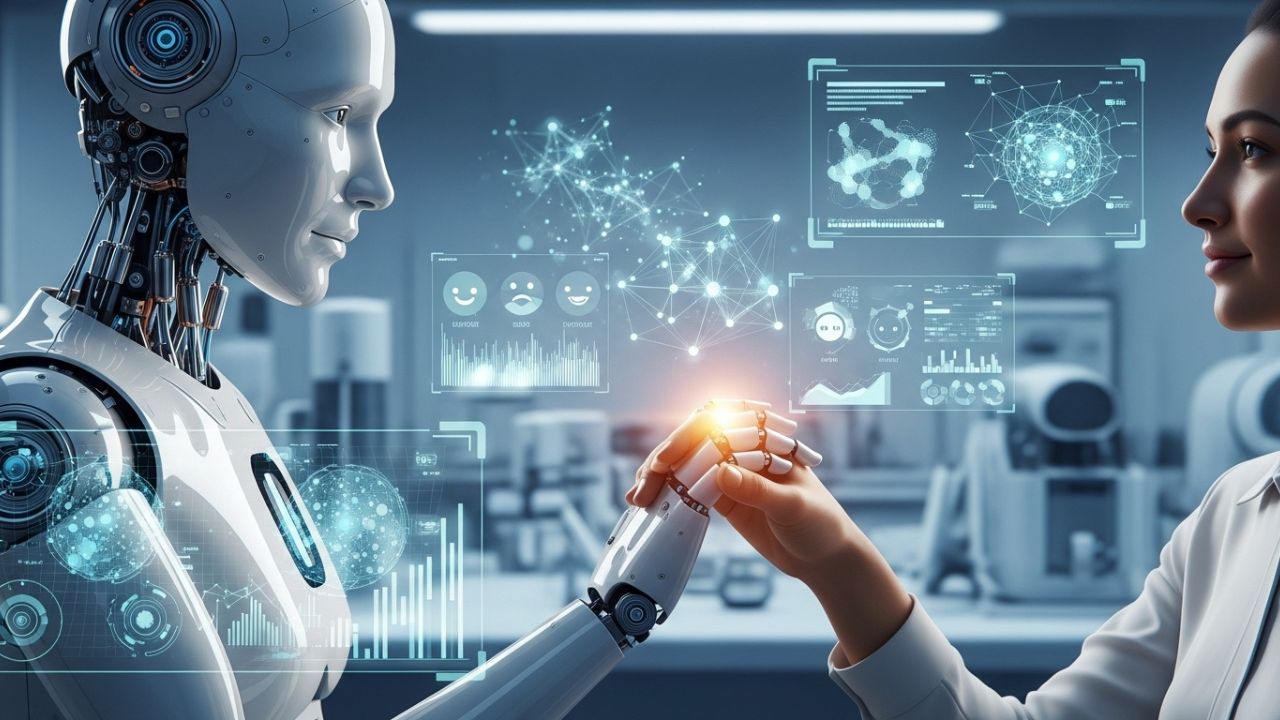
Emotional Intelligence in Artificial Intelligence: Artificial Intelligence is making rapid strides in its ability to mimic, interpret, and sometimes even respond to human emotions. The blend of emotional intelligence (EI) and AI raises a compelling question: Can machines truly understand human feelings, or are they simply simulating empathy with algorithms?.This article takes an authoritative, well-researched dive into the state of emotional intelligence in AI in 2025—covering scientific foundations, technology advancements, real-world applications, ethical debates, and the future outlook.
Introduction: The Quest for Emotional Machines
For decades, AI was synonymous with logical reasoning and computational power. Today, however, as machines increasingly interact with people—from virtual assistants to therapeutic bots—emotional intelligence has become an essential ingredient for effective human-AI collaboration. Emotional intelligence, once considered a uniquely human trait, is now entering the realm of silicon. Researchers, technologists, and behavioral scientists are embracing new frontiers. Where AI learns to read faces, interpret vocal tones, comprehend context, and adjust its responses in ways that often feel uncannily “human”.
What is Emotional Intelligence in AI?
Defining Emotional Intelligence
Emotional intelligence refers to the ability to detect, interpret, manage, and respond to emotions—both one’s own and those of others. For AI, this means recognizing subtle cues in speech, text, and images to not only understand what a person is feeling, but to also respond appropriately and constructively.
The Technological Stack
Modern emotionally intelligent AI systems typically blend:
- Natural Language Processing (NLP) with Tone Analysis: Deciphering not just the meaning of words, but the emotional subtext—such as sarcasm, frustration, or joy.
- Facial Expression Recognition: Using deep learning to classify emotions based on micro-expressions and facial movements, with models like EfficientMobileNet achieving up to 77.6% accuracy on large emotion datasets.
- Voice and Speech Analysis: Gauging stress, sadness, urgency, or excitement by analyzing pitch, cadence, and vocal patterns.
- Contextual Memory and Personalization: Remembering prior emotional states across interactions to improve rapport and tailor responses.
Read Also: Generative AI for Social Media Creators: The Shortcut to Viral Content
Recent Breakthroughs: Can AI Outperform Humans in Emotional Judgment?
Surprising Study Results
In 2025, researchers at the University of Geneva and University of Bern challenged six leading large language models (LLMs)—including ChatGPT-4 and Gemini 1.5 Flash—to widely-used emotional intelligence tests designed for humans. The AIs selected the “correct” emotionally intelligent response 81% of the time, compared to just 56% for human subjects. The study showed that, in certain controlled scenarios, AI can actually outperform humans at interpreting emotions and suggesting appropriate behavior.
Emotionally Intelligent Test Generation
Tests created by AI were validated by human experts for their difficulty and fidelity, showing a strong 0.46 correlation to original test items. This opens avenues for AI in coaching, education, and conflict management—domains traditionally dominated by human judgment.
Applications: Where EI-Enabled AI is Impacting Society
Empathetic Virtual Assistants
AI-powered assistants now analyze speech, facial cues, and conversation context to adjust their responses based on detected emotions. For example, if a user appears frustrated, the assistant slows down its speech and provides simpler, stepwise instructions.
Customer Service and Professional Services
A Deloitte study in 2025 found emotionally intelligent AI increased client satisfaction scores by 18% over standard AI tools. In financial services or legal consultation, EI-enabled bots can sense anxiety or hesitation and adapt their approach—reassuring clients, simplifying data, or providing additional explanations as needed.
Healthcare and Mental Health
AI is being deployed for preliminary mental health screening, monitoring mood disorders, and supporting therapy by recognizing emotional distress—even from low-quality images or unstructured speech.
Education and Team Collaboration
Adaptive learning tools use emotional signals to customise content delivery and support students or team members, improving engagement and retention.
The Science Behind Emotion Recognition
Nature-Inspired Neural Networks
AI’s ability to interpret emotion is grounded in deep neural networks inspired by the structure and function of the human brain. By processing massive datasets—including thousands of facial expressions, vocal recordings, and text samples. AI systems build pattern-recognition capabilities that mirror some aspects of human emotional judgment.
Multi-Modal Emotion Detection
The most advanced systems combine analysis of:
- Text (what’s said)
- Voice (how it’s said)
- Visual cues (how a person looks or behaves)
This “holistic” multi-modal approach helps AI resolve ambiguous cases—detecting, for example, when a client’s words conflict with their tone or facial expressions.
The Limits: Do AI Systems Truly “Feel” Empathy?
Simulation vs. Genuine Understanding
While AI can recognize and respond to emotions, it does not possess subjective experience, consciousness, or real empathy. Artificial empathy is programmatic—driven by algorithms designed to create better user experiences, not by true understanding or feeling. This distinction is crucial for setting expectations, particularly in sensitive domains like therapy, education, or personal assistance.
Ethical and Societal Concerns
- Privacy: Emotion-recognition tools rely on collecting intimate data—faces, voices, and behaviors—raising serious privacy and consent issues.
- Manipulation Risk: Machines that “understand” emotions could be used for persuasive marketing, behavioral nudges, or even political influence.
- Authenticity: Some worry that “artificial empathy” might blur lines between authentic and programmed care, potentially undermining trust in both AI and real relationships.
Can Machines Ever Develop Emotional Intelligence?
Current Science and Philosophical Debate
The consensus in 2025 is clear: machines can simulate emotion recognition—sometimes even outperform humans in tests—but cannot actually feel emotions. AI lacks subjective awareness, context from lived experience, and the embodied complexity that defines human emotional life. As Bernard Marr notes, emotions are “another form of data,” not felt experiences for machines.
However, through pattern detection and vast contextual analysis, AI is growing astonishingly good at making exchanges seem human. True emotional understanding remains an open challenge, likely reserved for future advances in AI psychology and philosophy.
Read Also: From Sketch to Masterpiece: How AI Turns Simple Drawings into Stunning Artworks
Frequently Asked Questions
How Accurate Is AI at Interpreting Emotions?
Recent deep learning models can reach 77-82% accuracy in emotion detection based on facial images, text, and speech in laboratory conditions.
Can AI “feel” emotions like humans?
No. AI can detect and model emotions but does not possess subjective experience, consciousness, or true empathy—it responds based on trained data.
Are emotionally intelligent AI systems already in use?
Yes. Major companies deploy EI-enabled AI in customer service platforms, healthcare apps, education tools, and professional service bots, improving satisfaction and personalized support.
What are the risks of emotionally intelligent AI?
Privacy, manipulation, loss of authenticity, and algorithmic bias are core concerns. Careful governance and ethical design are essential for safe deployment.
What is artificial empathy?
Artificial empathy refers to systems that can recognize and respond to emotional states, creating more “human-like” and supportive interactions—without truly feeling empathy.
Conclusion: The Future of Emotional Intelligence in AI
As AI becomes more emotionally intelligent, interactions between humans and machines will grow richer, smoother, and more adaptive. In 2025, machines can often detect and respond to feelings better than people in controlled scenarios, but the essence of human emotion—subjective, authentic, and embodied—remains out of reach for algorithms. The next phase in AI’s evolution will be not just about smarter machines, but about responsible, ethical design that respects privacy and preserves trust. The journey is ongoing, and while full emotional understanding may be an elusive goal. Emotionally intelligent AI is already transforming how we work, learn, and connect.