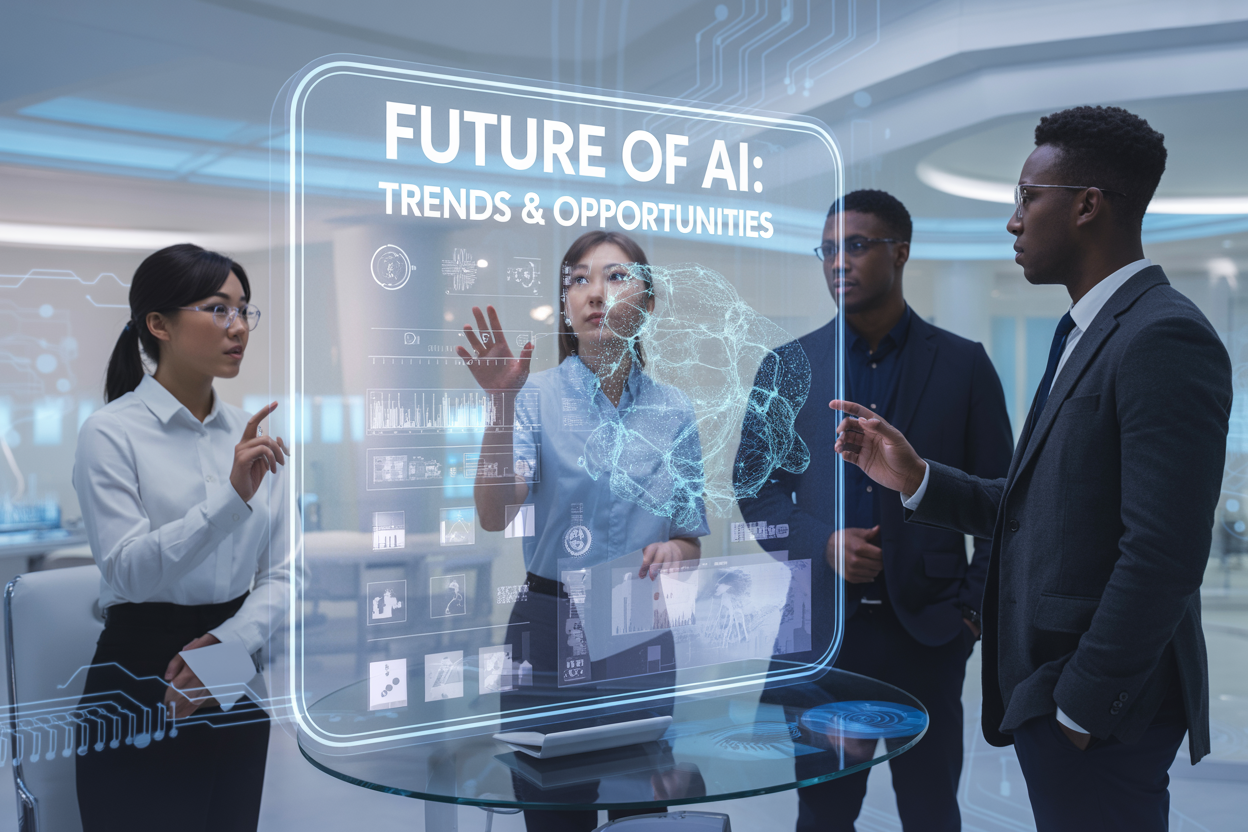
Artificial intelligence is reshaping business and society at breakneck speed. This comprehensive guide breaks down the artificial intelligence future trends, emerging AI technologies, and AI investment opportunities that savvy investors, business leaders, and technology professionals need to understand right now.
Who This Guide Is For:
- Investors seeking AI funding opportunities and smart investment strategies
- Business executives planning digital transformation initiatives
- Technology professionals tracking machine learning trends 2024
- Entrepreneurs exploring AI use cases across industries
The AI industry transformation is creating massive shifts in how companies operate, compete, and create value. We’ll explore the current artificial intelligence market landscape and dive deep into two critical areas that will define the next phase of AI growth.
First, we’ll examine the emerging AI trends transforming industries and reveal which high-impact AI use cases across sectors are delivering real results today. Second, we’ll analyze the investment landscape and funding opportunities, giving you the insights needed to make informed decisions about AI investment strategies.
By the end of this guide, you’ll have a clear roadmap for navigating the future of AI technology and positioning yourself to capitalize on the opportunities ahead.
Current State of AI Technology and Market Landscape

Key AI Technologies Driving Innovation Today
The artificial intelligence landscape is powered by several breakthrough technologies that are reshaping how businesses operate and people interact with digital systems. Machine learning, particularly deep learning neural networks, stands at the forefront of this revolution, enabling computers to recognize patterns, make predictions, and learn from data without explicit programming.
Natural language processing has reached remarkable maturity, with large language models like GPT-4 and Claude demonstrating human-like conversational abilities. These systems can understand context, generate creative content, and assist with complex reasoning tasks across multiple languages.
Computer vision technology has advanced dramatically, now capable of real-time object detection, facial recognition, and medical image analysis with accuracy that often exceeds human performance. This has opened doors for autonomous vehicles, medical diagnostics, and security applications.
Generative AI represents another significant leap forward, creating original content including text, images, code, and even music. Companies are integrating these tools into creative workflows, software development, and marketing campaigns.
Edge AI deployment is gaining momentum as organizations seek to process data locally rather than relying on cloud computing. This approach reduces latency, improves privacy, and enables AI functionality in remote locations or resource-constrained environments.
Market Size and Growth Projections
The artificial intelligence market landscape shows explosive growth across all sectors. Current market valuations place the global AI market at approximately $150 billion in 2024, with projections indicating it will reach $1.8 trillion by 2030, representing a compound annual growth rate of 36.6%.
| Market Segment | 2024 Value | 2030 Projection | CAGR |
|---|---|---|---|
| Machine Learning | $38B | $528B | 38.8% |
| Natural Language Processing | $24B | $144B | 35.1% |
| Computer Vision | $19B | $175B | 43.9% |
| Robotics | $31B | $218B | 38.2% |
Software applications dominate the market, accounting for roughly 60% of total AI revenue, while hardware infrastructure represents 25%, and services make up the remaining 15%. The enterprise segment drives the majority of spending, with companies investing heavily in AI-powered automation, analytics, and customer service solutions.
Regional distribution shows North America leading with 42% market share, followed by Asia-Pacific at 31%, and Europe at 20%. China and the United States compete for AI supremacy, with both nations making substantial investments in research, development, and infrastructure.
Venture capital funding in AI startups reached $50 billion globally in 2023, despite broader market challenges. This investment flow indicates strong confidence in AI’s commercial potential across industries.
Major Players Shaping the AI Industry
The AI ecosystem features a diverse mix of tech giants, innovative startups, and specialized companies driving different aspects of artificial intelligence development. These players are establishing the standards, platforms, and applications that will define the future of AI technology.
Technology Leaders:
- OpenAI revolutionized the industry with ChatGPT and GPT models, making advanced AI accessible to millions of users
- Google/Alphabet leverages its search expertise and cloud infrastructure through Google AI and DeepMind
- Microsoft has integrated AI across its product suite while partnering strategically with OpenAI
- Amazon dominates AI infrastructure through AWS and Alexa voice technology
- Meta focuses on AI research for social platforms and virtual reality applications
Hardware Infrastructure:
- NVIDIA controls 80% of the AI chip market with its specialized GPU technology
- Intel competes with dedicated AI processors and edge computing solutions
- AMD offers competitive alternatives for AI workloads
- Specialized chip companies like Cerebras and Graphcore target specific AI applications
Enterprise Solutions:
- Salesforce embeds AI into CRM and business applications
- IBM provides enterprise AI consulting and Watson technology
- SAP integrates AI into business process automation
- Oracle offers AI-powered database and analytics solutions
Startups continue to drive innovation in specialized areas like autonomous vehicles (Waymo, Cruise), AI safety (Anthropic), and vertical-specific applications across healthcare, finance, and manufacturing.
Regulatory Environment and Policy Developments
Governments worldwide are grappling with how to regulate AI development while fostering innovation. The regulatory landscape varies significantly by region, creating a complex environment for global AI companies.
The European Union leads with comprehensive AI regulation through the AI Act, which categorizes AI systems by risk levels and imposes strict requirements for high-risk applications. This regulation affects facial recognition, predictive policing, and AI systems used in hiring or education.
The United States takes a more decentralized approach, with the Biden administration issuing executive orders on AI safety while allowing industry self-regulation in many areas. Federal agencies are developing sector-specific guidelines for healthcare, finance, and transportation.
China balances AI innovation promotion with strict content control, particularly for AI systems that generate text, images, or interact with users. The country requires government approval for public-facing AI services and emphasizes data localization.
Key Regulatory Themes:
- Data privacy protections affecting AI training datasets
- Algorithmic transparency requirements for decision-making systems
- Safety standards for autonomous systems and critical applications
- Intellectual property rights for AI-generated content
- Export controls on advanced AI technology and semiconductors
Companies must navigate this evolving regulatory maze while building AI systems that comply with multiple jurisdictions. Many organizations are adopting “regulation by design” approaches, building compliance features into their AI systems from the ground up rather than retrofitting them later.
The regulatory environment will likely become more harmonized over time as international bodies work to establish common standards and best practices for AI development and deployment.
Emerging AI Trends Transforming Industries

Generative AI and Large Language Models Revolution
The rise of generative AI has completely changed how businesses think about automation and creativity. Large language models like GPT-4, Claude, and specialized industry models are now handling everything from customer service to content creation, code generation, and complex data analysis. Companies across sectors are discovering that these AI systems can produce human-quality outputs while working at unprecedented speeds.
What makes this trend particularly exciting is how these models are becoming more specialized and domain-specific. Healthcare organizations are training models on medical literature, while financial institutions develop AI systems that understand regulatory requirements and market dynamics. The democratization of AI development through platforms like Hugging Face and open-source models means even smaller companies can now build custom solutions without massive infrastructure investments.
The artificial intelligence future trends point toward multimodal capabilities becoming standard. Modern generative AI systems can now work with text, images, audio, and video simultaneously, opening doors to applications we couldn’t imagine just a few years ago. From automated video production to AI-powered design tools, these emerging AI technologies are reshaping creative industries and professional workflows.
Edge AI and Distributed Computing Solutions
Edge AI represents a fundamental shift from centralized cloud computing to distributed intelligence at the point of data generation. Smart cameras, IoT devices, autonomous vehicles, and industrial sensors now process data locally, reducing latency and improving privacy protection. This trend is particularly valuable for applications requiring real-time decision-making, like autonomous driving or predictive maintenance in manufacturing.
The benefits extend beyond speed. Edge AI solutions reduce bandwidth costs and improve system reliability by decreasing dependence on constant internet connectivity. Manufacturing facilities use edge AI for quality control, detecting defects in real-time without sending sensitive production data to external servers. Retailers deploy edge computing for inventory management and customer behavior analysis while maintaining data privacy.
Investment opportunities in edge AI infrastructure are growing rapidly. Companies developing specialized AI chips, edge computing platforms, and hybrid cloud-edge architectures are attracting significant funding. The convergence of 5G networks and edge computing creates new possibilities for mobile applications, augmented reality, and smart city initiatives.
AI-Human Collaboration and Augmented Intelligence
Rather than replacing human workers, the most successful AI implementations focus on enhancing human capabilities. Augmented intelligence systems work alongside professionals, handling routine tasks while humans focus on strategic thinking, creativity, and relationship building. Doctors use AI for diagnostic assistance while maintaining final decision-making authority. Financial analysts leverage AI for data processing while applying human judgment to investment strategies.
This collaborative approach addresses concerns about job displacement while maximizing the strengths of both human and artificial intelligence. Customer service teams use AI chatbots for initial inquiries, escalating complex issues to human agents who have access to AI-powered insights about customer history and preferences. Software developers work with AI coding assistants that suggest improvements and catch potential bugs, accelerating development cycles without replacing programmer expertise.
The key to successful AI-human collaboration lies in interface design and workflow integration. Companies investing in user-friendly AI tools that complement existing processes see higher adoption rates and better outcomes than those attempting to replace entire job functions.
Quantum AI and Next-Generation Computing
Quantum computing promises to unlock AI capabilities that classical computers simply cannot achieve. While still in early stages, quantum AI applications are showing potential for solving optimization problems, drug discovery, and financial modeling at scales previously impossible. Major tech companies and research institutions are investing billions in quantum research, creating opportunities for specialized quantum AI applications.
The intersection of quantum computing and machine learning could revolutionize how we approach complex problems like climate modeling, cryptography, and materials science. Quantum machine learning algorithms can potentially process vast datasets and identify patterns that would take classical computers years to analyze.
Current quantum AI investments focus on hybrid systems that combine quantum and classical computing, making this technology more accessible as it matures. Companies developing quantum software tools, quantum-safe security solutions, and quantum cloud services represent emerging investment opportunities in this transformative field.
Sustainable AI and Green Technology Integration
Environmental concerns are driving innovation in energy-efficient AI systems and sustainable computing practices. Data centers now account for significant global energy consumption, pushing companies to develop more efficient training methods and model architectures. Techniques like model compression, federated learning, and efficient neural architecture search are reducing the carbon footprint of AI deployment.
Green AI initiatives extend beyond energy efficiency to include AI applications for environmental monitoring, renewable energy optimization, and sustainable supply chain management. Smart grid systems use AI to balance renewable energy sources, while agricultural technology companies deploy AI for precision farming that reduces water usage and chemical inputs.
The business case for sustainable AI is compelling. Companies that prioritize energy-efficient AI systems reduce operational costs while meeting environmental regulations and consumer expectations. Investment in clean AI technologies offers both financial returns and positive environmental impact, attracting ESG-focused investors and forward-thinking organizations.
AI industry transformation increasingly includes sustainability metrics alongside performance measures. Organizations that integrate environmental considerations into their AI strategy position themselves advantageously for future regulations and market preferences favoring sustainable technology solutions.
High-Impact AI Use Cases Across Sectors

Healthcare Diagnostics and Personalized Medicine
AI is completely changing how doctors diagnose diseases and treat patients. Machine learning algorithms can now spot cancer cells in medical images with accuracy that matches or beats human radiologists. Google’s DeepMind developed an AI system that detects over 50 eye diseases from retinal scans, giving doctors results in just 30 seconds compared to weeks of waiting for specialist consultations.
Drug discovery has seen massive breakthroughs through AI use cases across industries. Traditional pharmaceutical development takes 10-15 years and costs billions of dollars. AI companies like Atomwise and BenevolentAI are cutting this timeline in half by predicting how molecules will behave and identifying promising compounds faster than ever before. During COVID-19, AI helped identify existing drugs that could be repurposed for treatment in just months instead of years.
Personalized medicine represents the biggest opportunity in healthcare AI. By analyzing patient genetics, lifestyle data, and medical history, AI systems create treatment plans tailored to each individual. IBM Watson for Oncology processes thousands of medical papers and patient records to recommend cancer treatments specific to each person’s unique situation. Tempus uses AI to analyze clinical and molecular data, helping oncologists choose the most effective therapies based on a patient’s specific tumor characteristics.
AI-powered diagnostic tools are making healthcare more accessible in underserved areas. Portable ultrasound devices with AI analysis can detect heart problems in rural clinics without cardiologists present. Smartphone apps can screen for diabetic retinopathy by analyzing photos of patients’ eyes, bringing specialist-level diagnostics to remote locations.
Autonomous Transportation and Smart Mobility
Self-driving cars represent one of the most visible artificial intelligence future trends reshaping transportation. Waymo has logged over 20 million miles of autonomous driving, while Tesla’s Autopilot system learns from data collected across millions of vehicles worldwide. The technology combines computer vision, sensor fusion, and real-time decision-making to navigate complex traffic situations.
Beyond passenger cars, autonomous trucks are revolutionizing freight transportation. Companies like TuSimple and Aurora are developing self-driving trucks that can operate 24/7 without driver fatigue, potentially reducing shipping costs by 30-40%. Walmart and UPS are already testing autonomous delivery vehicles for last-mile logistics, especially valuable during labor shortages.
Smart traffic management systems use AI to optimize traffic flow across entire cities. Los Angeles implemented an AI traffic control system that reduced travel times by 12% and cut emissions by 21%. These systems analyze real-time traffic patterns, weather conditions, and special events to adjust traffic signals and routing recommendations dynamically.
Electric vehicle charging networks are becoming smarter through AI optimization. Companies like ChargePoint use machine learning to predict charging demand, optimize energy distribution, and reduce peak load costs. AI algorithms help balance grid stability while ensuring EVs charge efficiently during off-peak hours.
Public transportation benefits from AI through predictive maintenance and route optimization. New York’s MTA uses AI to predict subway delays and maintenance needs before breakdowns occur. Ride-sharing platforms like Uber and Lyft rely heavily on AI for demand forecasting, dynamic pricing, and optimal driver-passenger matching.
Financial Services and Risk Management
Banks are using AI to transform everything from fraud detection to investment strategies. JPMorgan’s COIN system processes legal documents in seconds that previously took lawyers 360,000 hours annually. Goldman Sachs uses machine learning algorithms to execute trades and manage portfolios, with AI handling increasingly complex financial decisions.
Fraud detection has become incredibly sophisticated through AI pattern recognition. PayPal’s AI systems analyze over 19 billion data points to identify suspicious transactions in milliseconds. Credit card companies like Mastercard use AI to reduce false positives by 50% while catching more actual fraud attempts. These systems learn from every transaction, constantly improving their accuracy.
Credit scoring is being revolutionized by alternative data sources and AI analysis. Traditional credit scores only consider payment history and credit utilization. AI-powered platforms like Upstart analyze education, employment history, and even social media patterns to assess creditworthiness for people with limited credit history. This approach has helped approve 27% more loans while maintaining the same level of risk.
Algorithmic trading represents a massive application of AI investment strategies in financial markets. High-frequency trading firms use AI to execute thousands of trades per second, capitalizing on tiny price movements. Hedge funds like Renaissance Technologies have used AI and machine learning for decades, consistently outperforming traditional investment approaches.
Robo-advisors are democratizing investment management through AI. Platforms like Betterment and Wealthfront use algorithms to create and rebalance portfolios automatically, making professional-grade investment management available to regular investors at low costs. These systems consider risk tolerance, goals, and market conditions to optimize investment strategies.
Manufacturing Automation and Quality Control
Smart factories powered by AI are creating the next industrial revolution. General Electric uses AI to optimize jet engine manufacturing, reducing production time by 20% while improving quality. These systems monitor every aspect of production in real-time, from temperature and pressure to tool wear and material quality.
Predictive maintenance prevents costly equipment breakdowns before they happen. Bosch’s AI systems analyze vibration patterns, temperature fluctuations, and sound signatures to predict when machines need maintenance. This approach reduces unplanned downtime by up to 50% and extends equipment lifespan significantly.
Quality control has reached new levels of precision through computer vision and machine learning. BMW uses AI-powered cameras to inspect car parts with accuracy impossible for human inspectors. These systems can detect defects smaller than a human hair and classify different types of problems automatically.
Supply chain optimization through AI helps manufacturers respond to disruptions and demand changes. Amazon’s supply chain AI predicts inventory needs, optimizes warehouse operations, and coordinates deliveries across millions of products. During the pandemic, companies with AI-powered supply chains adapted much faster to changing conditions.
Collaborative robots, or “cobots,” work alongside human workers with AI guidance. These systems learn from human demonstrations and adapt to different tasks without extensive reprogramming. Companies like Universal Robots create AI-powered cobots that can switch between assembly tasks, quality inspection, and material handling based on production needs.
Investment Landscape and Funding Opportunities

Venture Capital Trends in AI Startups
The AI investment strategies landscape has transformed dramatically over the past few years, with venture capitalists pouring unprecedented amounts into AI startups. In 2023, AI companies attracted over $29 billion in venture funding globally, representing a 76% increase from the previous year. This surge reflects growing confidence in AI’s commercial potential across multiple sectors.
Early-stage AI funding has shifted toward companies with clear paths to revenue generation rather than purely research-focused ventures. VCs are prioritizing startups that demonstrate practical applications of AI technologies, particularly those addressing enterprise needs like automation, decision-making, and data analytics. The average Series A funding round for AI startups has grown to $15 million, up from $8 million just three years ago.
Geographic distribution of AI funding opportunities shows Silicon Valley maintaining its lead with 42% of total investments, followed by Boston (18%) and New York (12%). However, emerging hubs in Austin, Seattle, and international markets like London and Toronto are gaining significant traction.
Corporate AI Investment Strategies
Fortune 500 companies are deploying sophisticated AI investment strategies beyond traditional R&D spending. Corporate venture capital arms have become major players, with companies like Google Ventures, Intel Capital, and Salesforce Ventures leading substantial AI funding rounds.
Strategic acquisitions dominate corporate AI investment portfolios. Tech giants have completed over 150 AI-related acquisitions in the past 18 months, with average deal sizes ranging from $50 million to $2 billion. Microsoft’s partnership and investment approach with OpenAI exemplifies how corporations are securing access to cutting-edge AI technologies through hybrid investment models.
Internal AI development budgets have skyrocketed across industries. Manufacturing companies are allocating 15-20% of their technology budgets to AI initiatives, while financial services firms are investing heavily in fraud detection, risk assessment, and algorithmic trading systems. Retail giants like Amazon and Walmart continue expanding their AI infrastructure investments, focusing on supply chain optimization and personalized customer experiences.
Public Market AI Stock Performance
AI-focused publicly traded companies have delivered exceptional returns, outperforming broader market indices by significant margins. The AI sector has generated average annual returns of 28% over the past three years, compared to 12% for the S&P 500.
| Company Category | 3-Year Return | Market Cap Growth |
|---|---|---|
| Pure-Play AI | 145% | $420B |
| AI-Enhanced Tech | 89% | $1.2T |
| Traditional + AI | 34% | $800B |
NVIDIA leads the pack with returns exceeding 200% over three years, driven by demand for AI chips and data center hardware. Software companies integrating AI capabilities, including Palantir, C3.ai, and UiPath, have shown remarkable growth trajectories despite market volatility.
Investor sentiment toward AI stocks remains bullish, with institutional investors increasing their AI allocations by 45% in 2023. ETFs focused on artificial intelligence and machine learning have attracted over $8 billion in new assets, reflecting growing mainstream interest in AI investment opportunities.
Government Funding and Research Initiatives
National governments worldwide are launching massive AI funding programs to maintain technological competitiveness. The U.S. National AI Initiative has allocated $2 billion annually for AI research and development, while China’s national AI strategy includes $150 billion in planned investments through 2030.
European Union’s Horizon Europe program dedicates €7 billion specifically to digital and AI technologies, emphasizing ethical AI development and cross-border collaboration. The UK’s AI Sector Deal includes £1 billion in government and industry commitments, focusing on healthcare, manufacturing, and autonomous vehicle applications.
Research grants are increasingly targeting practical AI applications rather than theoretical research. The National Science Foundation’s AI for Future of Work program provides $100 million annually for projects demonstrating real-world impact on employment and productivity.
ROI Metrics and Success Indicators
Measuring AI investment returns requires sophisticated metrics beyond traditional financial indicators. Companies are tracking AI-specific KPIs including model accuracy improvements, automation savings, and revenue attribution from AI-driven features.
Successful AI investments typically show measurable business impact within 12-18 months. Cost reduction through automation averages 25-40% in targeted processes, while revenue enhancement from AI-powered features contributes 8-15% to overall company growth.
Key performance indicators for AI investments include:
- Time to Value: Average 14 months for enterprise AI implementations
- Productivity Gains: 20-35% improvement in targeted workflows
- Customer Satisfaction: 15-25% increase in AI-enhanced services
- Market Share Growth: 5-12% advantage over non-AI competitors
Risk-adjusted returns for AI investments currently average 35% IRR for early-stage ventures and 22% for later-stage investments, significantly outperforming traditional technology sector benchmarks.
Future Challenges and Strategic Considerations

Ethical AI Development and Bias Mitigation
The artificial intelligence future trends point toward an urgent need for ethical frameworks that can keep pace with rapidly advancing technology. Organizations investing in AI systems face mounting pressure to address algorithmic bias before it becomes embedded in critical decision-making processes.
Machine learning models often reflect the biases present in their training data, creating a cascade effect that can perpetuate or amplify societal inequalities. Financial institutions using AI for loan approvals have discovered their algorithms favor certain demographic groups, while healthcare AI systems show varying accuracy rates across different ethnic populations. These issues don’t just represent moral failures—they create significant legal and financial risks for companies.
Leading tech companies are now implementing comprehensive bias testing protocols throughout their development cycles. Microsoft has developed fairness metrics that evaluate AI models across multiple demographic dimensions, while Google has created tools that help developers identify and correct biased patterns in their datasets. These approaches involve diverse testing groups, continuous monitoring after deployment, and regular audits by external experts.
The European Union’s AI Act and similar regulations emerging globally are forcing companies to prioritize ethical AI development. Organizations that fail to address these concerns early will face regulatory penalties and reputational damage that could severely impact their AI investment opportunities.
Talent Shortage and Skills Gap Solutions
The AI industry transformation has created an unprecedented demand for specialized talent that far outstrips current supply. Companies across all sectors are competing for the same pool of data scientists, machine learning engineers, and AI researchers, driving salaries to record highs and leaving many positions unfilled.
This talent crunch affects more than just technical roles. Organizations need professionals who can bridge the gap between AI capabilities and business applications, including AI ethicists, product managers with ML experience, and domain experts who understand how to apply artificial intelligence market landscape insights to specific industries.
Companies are responding with creative talent acquisition and development strategies:
- Upskilling Programs: Major corporations are investing heavily in retraining existing employees, with Amazon committing $700 million to upskill 100,000 workers
- University Partnerships: Tech giants are collaborating with academic institutions to develop specialized AI curricula and secure early access to graduating talent
- Remote Work Expansion: Companies are hiring globally to access talent pools previously limited by geography
- AI-Assisted Development: Organizations are using AI tools to augment their existing teams, allowing less specialized developers to work on AI projects
The most successful companies are also focusing on creating inclusive environments that attract diverse talent, recognizing that varied perspectives improve AI system design and reduce bias risks.
Data Privacy and Security Concerns
Data privacy represents one of the most complex challenges facing AI deployment across industries. The very foundation of effective AI systems—large datasets containing personal information—conflicts with growing privacy expectations and regulatory requirements.
Modern AI applications require vast amounts of data to function effectively, but traditional data collection practices are becoming increasingly problematic. Social media platforms, healthcare providers, and financial institutions must balance their need for comprehensive datasets with user privacy rights and regulatory compliance.
Emerging AI technologies are developing innovative solutions to these challenges:
| Privacy Technique | Application | Benefits |
|---|---|---|
| Federated Learning | Healthcare, Finance | Training without centralizing data |
| Differential Privacy | Analytics, Research | Mathematical privacy guarantees |
| Synthetic Data | Testing, Development | Realistic data without personal info |
| Homomorphic Encryption | Cloud Computing | Processing encrypted data |
Security concerns extend beyond privacy to include AI system vulnerabilities. Adversarial attacks can manipulate AI models to produce incorrect outputs, while model inversion techniques can extract sensitive information from trained models. Financial institutions and healthcare providers are particularly vulnerable to these attacks, as compromised AI systems could affect critical decisions.
Organizations pursuing AI investment strategies must now budget for comprehensive security measures, including regular penetration testing of AI systems, secure data handling protocols, and incident response plans specifically designed for AI-related breaches. The companies that successfully navigate these challenges will establish competitive advantages in the growing AI marketplace, while those that ignore these risks face potential catastrophic failures that could derail their AI initiatives entirely.

AI technology has already moved beyond science fiction into our daily reality, reshaping everything from healthcare diagnostics to financial services. The trends we’re seeing today—from generative AI to autonomous systems—are creating massive opportunities across industries while opening up new investment avenues for both institutional and individual investors. Companies that embrace these innovations early are positioning themselves for significant competitive advantages.
The road ahead won’t be without its bumps. Technical hurdles, ethical concerns, and regulatory challenges will continue to shape how AI develops and gets deployed. Smart investors and business leaders need to stay informed about these evolving dynamics while identifying the most promising opportunities. Now is the time to start building your AI strategy, whether you’re looking to invest in the next breakthrough company or integrate these powerful technologies into your own business operations.